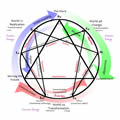
Enneagram as Second Nature... An example of a group exchange
John G. made a comment in the July 2nd meeting that it would be nice to have the insights available through understanding the enneagram as part of our “second nature”. This led me to formulate some of the aspects or “questions” that we would be able to answer about any situation, event, object or project if the enneagram was truly part of our second nature.
It might look something like the following: In any situation can I immediately see or identify…
- The central logos of the event
- Each of the three “shocks” entering the enneagram
-
Each of the three processes initiated by those three impulses
- The functional process from 0 to 3
- The transformational process from 3 to 6
- The process of realization from 6 to 9
- The triadic nature of the three shocks
- The triadic nature of the secondary triads 2-8-5 and 7-1-4
- The lateral connections between 1-8, 2-7, 3-6, 4-5
- The characteristics of all 9/10 points
- The ‘smaller’ complete enneagram of each point
- The characteristics of the lines linking the three shock points
- The characteristics of the six lines between 1-4-2-8-5-7
- The overall outward process going around the circle
- The octave from Do to Do… both ascending and descending
I’ll stop at twelve, but feel free to add your own favorite aspects or edit any of the above.
IMPORTANT: Don't be mislead by the linear, apparently technical listing given above. The point of having the enneagram be part of our "second nature" means that we directly see the substance and implications of any of the elements listed above as they apply to a particular, immediate situation. Only secondarily would we say, "Oh, that's the 7-1 line."
- Log in to post comments
Comments
Left Hand ---- Right Hand approach
The 1-4-2 verses the 8-5-7 ways of looking at the enneagram
Areas of Interest
What new material have you added to the next edition of Intelligent Enneagram?
How do we make an "enneagram perception" truly second nature?
Understanding the lines 0-3-6-9
How to start?
How NOT to mix different enneagrams?
Guidelines for sorting out the 'mix'
The two sides of the enneagram
Descending octave and the notion that the time for something has come
Applying the enneagram to this feeling that the "time has come for something"
What is his personal relationship to the enneagram
Mapping the triads to the enneagram
History of the enneagram
The enneagram as presented is an incomplete tool
What does he consider important to add to our enquiry
Are the inner lines "will", and the triangle "being"? or the opposite? or does it change? Same with time, eternity, and hyparxis?
Labeling of the 0-3-6-9 lines
Comment on our evolving enneagram diagrams
re: History of the enneagramma
J, thanks for mentioning this. The history is of interest to me, too. I was struck by Blake's comment in the Intelligent Enneagram that the earliest known reference to the diagram was not that long ago (800 A.D.?). I'd expected thousands of years, Babylon and the Zoroastrians.
Look Out!!!!
After reading some of the comments in the Kindle version of TIE (The Intelligent Enneagram), mostly in his Introduction to the new addition, I'm beginning to understand better that instead of saying, as I did above, "In any situation can I immediately see or identify…", it might be better to ask, "When I look out from the 7-1 line, what do I see? How does it feel? What sense of movement do I perceive?
He says, "Putting oneself in the middle of the action instead of somewhere, somehow, 'above' it is crucial."
It's the shift from looking down into the enneagram to entering into it and then looking out.
look with...
I'm coming to the same conclusion.
fostering the feeling of being immersed or 'seeped' (steeped?).
logged in
Never blogged before but...getting my nerve up!